
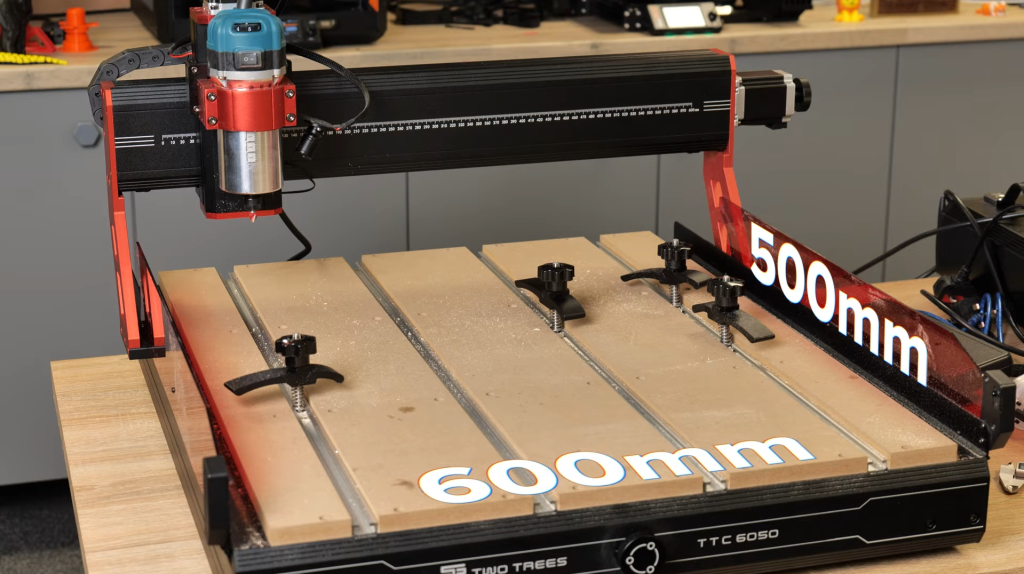
If you’ve ever looked at a CNC router and wondered whether it could actually cut accurately without endless tuning, upgrades, or frustration, you’re not alone.
Most people start with small desktop CNCs. They’re fine for engraving. Maybe light cuts. But once you try to build real projects—full panels, repeatable parts, or anything that needs precision, you quickly hit their limits.
That’s why 6050-class CNC routers exist.
In this post, I’m breaking down the Two Trees 6050 CNC based on a detailed hands-on video review by Steve from 123-3D, combined with what matters most to buyers: accuracy, rigidity, workflow, and long-term value.
If you want a CNC that feels closer to industrial quality—without paying industrial prices—this machine deserves serious consideration.
👉 Check the current price and availability on Amazon
Who This CNC Is Actually For
Before we get into specs and features, let’s be clear about who this machine is meant for.
The Two Trees 6050 is ideal if you:
- want a large work area (600×500mm)
- care about accuracy and repeatability, not just engraving
- build projects that need to fit together properly
- are ready to move beyond belt-driven or V-wheel machines
- don’t want to spend months upgrading a weaker CNC
If you only engrave tiny signs or want the cheapest possible CNC to experiment with, this is probably more machine than you need. But if you want a CNC that can grow with you, keep reading.
Why This Review Matters (and Why the Video Is Important)
A lot of CNC reviews repeat spec sheets. This one doesn’t.
In the video, the Two Trees 6050 is:
- assembled from the kit
- tested on real materials
- measured with calipers and steel rules
- pushed beyond light woodworking
That matters because accuracy claims only mean something when they’re tested in the real world.
Real Accuracy Tests (The Part Buyers Care About Most)
One of the strongest moments in the video is the accuracy testing.
Steve mills a 10mm channel in aluminum and measures it with calipers. The result is right on target, with tolerance well within what most makers would consider excellent for this price range.
He then cuts a geometric shape from 18mm MDF, modeled at 173mm, and checks it across multiple axes. The dimensions match consistently, with no visible X/Y distortion.
Why does this matter?
Because accuracy isn’t just about numbers—it’s about confidence. When you know the machine cuts what you design, you waste less material, spend less time fixing mistakes, and can actually trust your CAD files.
What Makes the Two Trees 6050 Feel “Different”
This is where the Two Trees 6050 separates itself from many hobby CNCs.
Instead of belts, V-wheels, or light lead screws, this machine uses ball screws and linear rails on all axes. That design choice alone puts it in a different category.
Ball screws reduce backlash. Linear rails provide smooth, rigid motion. Combined with large NEMA 23 stepper motors and thick aluminum gantry plates, the machine feels solid and stable even under more demanding cuts.
In the video, Steve physically measures the gantry plates at 12mm thick, and reports zero visible flex during use. That kind of rigidity is exactly what you want if you care about repeatability.
Work Area and Travel: Why 6050 Size Matters
The cutting area is 600 × 500mm, with 100mm of Z travel.
That size hits a sweet spot. It’s large enough to:
- cut full panels
- create jigs and templates
- run repeatable production jobs
At the same time, it’s still realistic for a home workshop or small maker space. You’re not jumping straight into a full industrial machine with massive power requirements.
Spindle Options: Start Simple, Upgrade When Ready
The Two Trees 6050 ships with a variable-speed, air-cooled spindle rated up to 12,000 RPM. For woodworking, v-carving, and general CNC work, this spindle performs well.
In the video, Steve demonstrates clean v-carving on walnut using the stock spindle, with good surface finish.
To push the machine further, he installs an upgraded 800W spindle capable of 30,000 RPM, which is used for aluminum milling tests. The upgrade requires manual RPM control, but it significantly expands what the machine can handle.
The key takeaway is flexibility. You don’t need to buy everything at once. You can start with the stock setup and upgrade later if your projects demand it.
Control System and Day-to-Day Workflow
The machine uses a standalone control box, not a tiny controller bolted to the frame. This box includes active cooling, which is important given the size of the motors and drivers.
The touchscreen interface allows you to:
- jog axes in fine increments
- set origins accurately
- home the machine
- probe Z-height automatically
Steve demonstrates the probing process live in the video, showing how quickly and reliably the machine sets the material zero.
The firmware is GRBL-based and compatible with popular CAD/CAM tools like Fusion 360, Easel, Carveco, and ArtCAM. That means you’re not locked into proprietary software.
Safety and Build Details You’ll Appreciate Long-Term
This is one of those machines where the small details add up.
There’s an infrared safety beam at the front that pauses the machine if something enters the cutting area. You can disable it, but it’s a nice extra layer of protection.
Dust guards, side shields, cable chains, and a replaceable sacrificial MDF spoilboard all point to a machine designed for regular use—not occasional experimentation.
The spoilboard design is especially practical. If you cut into it, you don’t replace the whole thing. You just swap out the damaged section.
Dust Collection: Not Optional
CNC routers generate a lot of dust. The video shows a dedicated dust shoe and vacuum system designed for CNC use, including magnetic attachments and optional lighting.
If you buy this machine, plan for dust control from day one. It protects your health, your cuts, and the machine itself.
What This Machine Is Not (Honest Cons)
No CNC is perfect, and honesty helps buyers make the right choice.
This machine is:
- large and heavy (not easy to move)
- not beginner-friendly if you refuse to learn CAD/CAM basics
- more than you need if you only engrave small items
If you want a tiny plug-and-play engraver, look elsewhere. If you want a CNC that can actually grow with your skills, this one makes sense.
Final Verdict: Is the Two Trees 6050 Worth Buying?
If you’re shopping for a 6050-class CNC router, the Two Trees 6050 stands out for one main reason:
You’re getting ball screws, linear rails, and real rigidity without paying industrial-level prices.
That combination is rare in this segment.
For makers who value accuracy, stability, and long-term usefulness, this machine offers excellent value.
If you want a more project-focused, hands-on perspective (especially for real builds and production workflows), read this next: